
Hill Walking Club
Safety In The Hills
Enjoying Scotland’s mountains safely means having the right skills and knowledge to cope with the conditions you’re going to meet.
This section of the website outlines some of the essential skills you should master, including navigation and a knowledge of the effects of weather and conditions, along with ways to avoid or cope with any risks involved.
Where you lack particular skills, it may be that one of our courses can fill in the gaps in your knowledge or help you hone and refresh existing skills.
There’s also that knowledge which requires updating for every trip: what the weather is likely to do, and what the snow and avalanche conditions are.
Essential skills
Information source: ( https://www.mountaineering.scot/ )
There are a number of skills essential for anyone wishing to take responsibility for themselves in the Scottish mountains, whether walking, climbing or mountaineering, and whether in summer or winter. Read more here about those skills and how to acquire them.
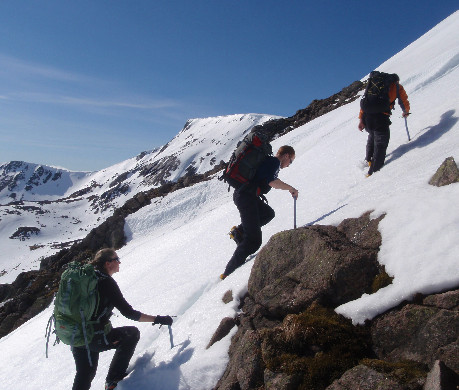
Mountaineering: the essential skills
It’s more than just keeping safe: learning the essential skills of hill walking and mountaineering means you will get so much more pleasure and satisfaction from your trips to the hills.
Instead of never knowing quite where you are and relying on companions to guide you, you can have the satisfaction of planning and following your own routes, knowing at all times where you are and what you are seeing round you.
And instead of not knowing what to do in the face of changing conditions, you can have the confidence and self-reliance to make sensible decisions for yourself.
Navigation
Navigation is one of the key outdoor skills. In this section you can learn about maps and how to use them, about planning and following a route, and – crucially – what to do if you seem to have gone wrong. There are also sections about GPS and smartphone navigation apps.
Weather and avalanche safety
There’s a lot more to the weather than checking whether there’s a cloud or a sunshine symbol on the TV weather map. Find out more about what effect the weather and conditions will have on your mountain plans. And learn about the dangers of avalanches and how to deal with them.

First Aid
First Aid is something everyone should have at least some knowledge of, especially when out in the mountains and potentially many miles – and hours – from assistance. Find out more about First Aid – particularly with relation to walking and climbing.
Mountain rescue
We would all hope never to need rescue but if the worst should happen, then you need to be prepared. Whether you need to call help for yourself or for someone else, you should know how and how to be most assistance to the rescuers.
Choosing a guide
If you’re going down the road of hiring professional assistance, you want to make sure you get the right person for the job. Check here for the questions you should be asking.
Health and hygiene
Is the water safe to drink? Where do I go for the toilet?
Two of the most commonly asked questions – and the answer to one can have a bearing on the other! Read more before you go.
Training
The Club encourages members to become proficient in all aspects of hillcraft, including navigation, winter skills and first aid. Most simply, participation in Club meets (e.g. in the President’s Party: see under “Day Meets” in the “Club Activities” page), and walking in company with more experienced members, should help new members to acquire some skills and confidence. Occasionally, the Club organises its own courses at minimal cost; details are given in the newsletters, or made known via the email system. It can also offer financial support up to 50% of the cost of training and assessment courses offered elsewhere (e.g. at Glenmore Lodge), provided that some Club benefit (e.g. meet organisation) is envisaged: members should apply in advance to the Training Co-ordinator with details of the course and its cost.
Club members cannot train you in rock or ice-climbing; this is better done professionally. However, once the basics are learnt, you will be able to gain experience with fellow-members.
Winter mountaineering in Scotland
Information source: ( https://www.mountaineering.scot/ )
Winter mountaineering in Scotland offers some of the best mountain days anywhere, with rugged, challenging mountains, the sharp bite of clean, cold mountain air, and crystal clear views of incredible snowy vistas under clear blue skies.
On the flip side, winter mountaineering in Scotland also offers howling winds you can’t stand up in, choking spindrift and zero visibility in white-outs and thick, claggy cloud. Weather patterns are unpredictable and change rapidly from warm and wet to cold, storm force blizzards.
It’s all worth it for the good days, but anyone heading for the Scottish mountains in winter must be prepared for the worst – and that’s why the experts say that any ascent of Scotland’s mountains in winter should be regarded as mountaineering rather than hill walking.
In winter conditions – and those are determined by the presence of snow and ice rather than calendar date – safe ascent and descent are likely to be dependent on the use of technical equipment such as ice axes, crampons and even skis, and associated mountaineering skills.
There is also a distinct lack of way-marked paths in the higher mountain areas, making easy access impossible. The wild land areas, although shrinking, are still large enough to mean considerable distance may have to be travelled across rough terrain in order to climb many cliffs, ridges and mountain tops.
This lack of paths and tracks means mountaineers need to be skilled in navigation and be self-sufficient.
Safety is a priority
Safety should always be a priority, but it really does become a prime consideration in winter conditions. You should be thoroughly familiar with all the advice and techniques contained in the Safety & Skills section of our website. You can also learn from the mistakes of others, on our Near misses page, where many of the mishaps occurred during winter conditions.
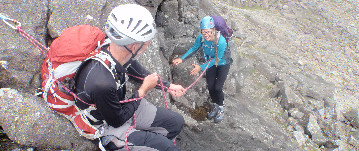
Mountaineering Gear
Which boots for winter mountaineering?
Boots are probably the most important item of winter equipment. The type of boots you use should vary depending on the terrain and under foot conditions you expect to encounter.
It is not the case that one pair of boots will be good for every situation you might find yourself in in the mountains. As an extreme example, a summer walk in the Pentland Hills on dry, grassy terrain will require very different footwear to ascending a Munro in winter conditions.
You need to choose your footwear carefully, as secure footwork is essential for safe mountain travel. To put this into context, around one quarter of mountain rescue incidents are as a direct result of someone taking a slip in the wrong place and becoming injured.
In summer conditions a flexible fabric or leather boot with a Vibram sole is recommended. Some folk will be happy to use approach shoes, but remember they will have little or no ankle support.
In winter, however, underfoot conditions can be very challenging. Stiff-soled boots provide the security you need, with rigid side edges and toes for creating secure footsteps and holding a crampon. On slopes which are of sufficient angle for a slip to become a fall or an uncontrollable slide, stiff soled boots are more secure because the side edges and toes are more effective at creating secure footsteps.
To make the purchase of the correct type of boot easier, a ‘rating’ system has been established, and all good outdoor retailers will use this system.
Choosing the boots and crampons
Video guide: ( https://youtu.be/ulhbiKyn6vc )
From the storeroom at Glenmore Lodge: advice on the differences between boots and how to choose the right boot for your activity – and how to choose the right crampons to fit.
Boot Ratings
B0 – A flexible three-season walking boot, generally with thin leather or fabric uppers, intended for summer or light year-round hill walking with the emphasis on comfort. Use of crampons is not recommended as the boot does not provide a sufficiently stable platform, leading to the danger of the crampon becoming detached in use.
B1 – Four-season hill walking boots with a semi-stiffened midsole and a more supportive and durable leather upper. This allows the use of crampons for walking on short sections of easy snow and ice.
B2 – An almost fully stiffened four-season mountain boot with a thicker upper, higher ankle profile and usually the facility for crampons with heel clip bindings to be fitted.
B3 – A totally rigid technical mountain boot, allowing the use of crampons with heel clips and wire toe bails. For everything from walking to technical and high-altitude mountaineering or hard ice/mixed climbing, depending on design.
For professional advice on what brand and type of boot to purchase for your chosen activity check with your local professional outdoor retailer such as Tiso, Cotswold, Nevisport or Craigdon Mountain Sports.
- Phone Number: 0999 999999
- Address: ABC Road Near Hill
- Post Code: AB99 9AB
- Email: HillwalkingClub@email.com